Pangolin Conservation in Central Africa
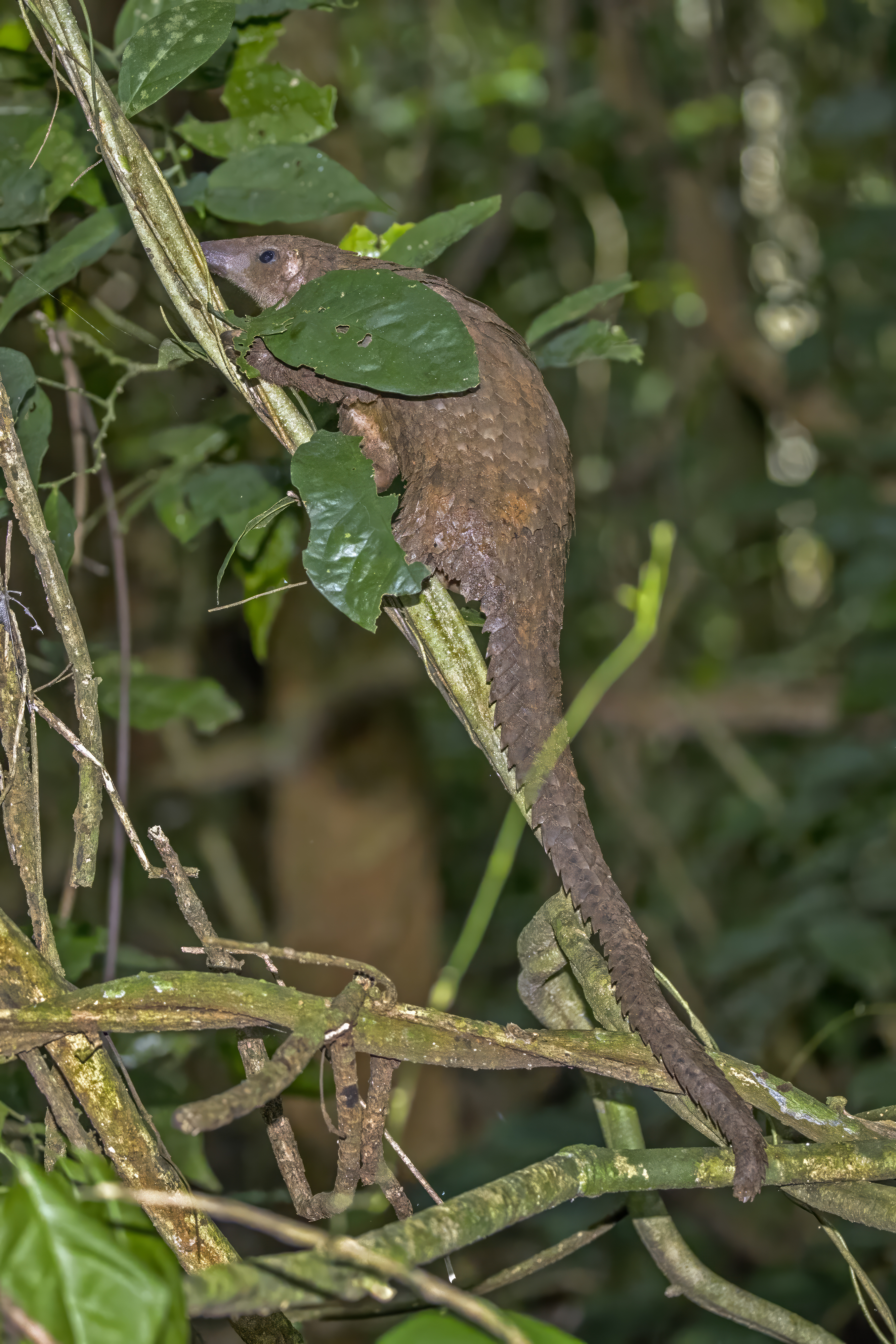
Central Africa — spanning the Democratic Republic of Congo, Cameroon, Gabon, Republic of Congo, and Equatorial Guinea — harbours the densest remaining populations of pangolins on Earth, yet receives a fraction of the global conservation funding directed at Southeast Asian species. The Congo Basin's vast, largely intact rainforest is both a refuge and a battleground for three distinct pangolin species.
The Species of Central Africa
Three pangolin species share the Central African forest landscape, each occupying a distinct ecological niche:
- Giant ground pangolin (Smutsia gigantea) — the largest of all pangolin species, reaching up to 1.8 metres in length. Found across DRC, Cameroon, and Gabon, this nocturnal terrestrial forager excavates termite mounds and ant colonies from hardened savanna and forest-edge soils.
- White-bellied (tree) pangolin (Phataginus tricuspis) — the most heavily traded pangolin species globally. Abundant across the Congo Basin's closed-canopy forest, it is highly arboreal and forages for ants and termites in tree bark crevices. Its population trajectory is described by IUCN as declining.
- Black-bellied (long-tailed) pangolin (Phataginus tetradactyla) — a slender, prehensile-tailed species adapted to riverine forests, gallery forests, and swamp environments. It is the least studied of the three and is increasingly detected in camera trap surveys throughout the Congo Basin's wetland margins.
The Democratic Republic of Congo
The DRC contains the second-largest tropical forest on Earth — approximately 155 million hectares, second only to the Amazon. This vast wilderness is home to all three Central African pangolin species, making it arguably the most important country on the planet for pangolin conservation.
The bushmeat crisis is acute. White-bellied pangolins are heavily hunted in the Kinshasa basin, where urban demand for wild protein intersects with poverty-driven hunting. Trafficking routes are well-documented: whole pangolins and bushmeat travel to Kinshasa's sprawling markets, while dried scales are separated and shipped to Asia via air cargo through N'djili International Airport.
Conservation organisations active in DRC include the African Wildlife Foundation (AWF), the Zoological Society of London (ZSL Congo), and WWF-DRC. Virunga National Park — Africa's oldest national park — has embedded pangolin monitoring into its ranger patrol system, generating long-term detection data in the park's forest sectors. The challenges are formidable: ongoing armed conflict involving groups such as the ADF and M23 renders large portions of the country inaccessible, infrastructure is extremely poor, and institutional corruption undermines law enforcement at every level.
Cameroon — A Trafficking Crossroads
Cameroon has earned the grim distinction of being one of the world's most significant transhipment hubs for pangolin scales bound for Asian markets, principally China and Vietnam. TRAFFIC data covering 2015–2023 consistently places Cameroon among the top five countries by seizure volume, reflecting both genuine enforcement activity and the volume of product moving through the country.
Douala's deep-water port and Yaoundé's Nsimalen International Airport are the primary exit points. Scales are concealed in timber shipments, agricultural cargo, and personal luggage. The scale of the trade is staggering: a single 2019 seizure at Douala port yielded 8.8 tonnes of pangolin scales — representing approximately 17,600 individual animals.
Conservation responses include WWF Cameroon's community-based monitoring, the Wildlife Conservation Society (WCS), and the Last Great Ape Organisation (LAGA), which provides critical support to enforcement agencies, documenting cases and ensuring prosecutions proceed. The Dja Faunal Reserve, a UNESCO World Heritage Site in southern Cameroon, is one of the last strongholds of the giant ground pangolin and is the focus of long-term population studies. Under Cameroonian law (Law No. 94-01 on forestry, wildlife and fisheries), pangolins are Class A protected species — meaning any killing, capture, or trade carries criminal penalties. The gap between law and enforcement, however, remains wide, partly due to corruption within the Ministry of Forestry.
Gabon's Conservation Leadership
Gabon stands apart among Central African nations for the ambition of its conservation architecture. Approximately 88% of the country's land surface is covered by forest, and the government has established 13 national parks covering around 11% of national territory, alongside 13% marine protected areas — among the most comprehensive in Africa.
Lopé National Park in central Gabon has been the site of long-term giant ground pangolin tracking studies, including GPS-collar research that has generated some of the most detailed home-range data available for any African pangolin species. The Agence Nationale des Parcs Nationaux (ANPN) trains rangers in pangolin detection and response protocols. In 2021, Gabon took the significant step of banning commercial bushmeat hunting — a policy that, if enforced, would substantially reduce pressure on all three Central African species. The Smithsonian Tropical Research Institute has contributed density estimation studies that provide a baseline for population monitoring in Gabonese forest.
The Congo Basin Threat Landscape
The threats facing Central African pangolins are deeply structural. Commercial bushmeat trade feeds rapidly growing urban populations: Kinshasa now has over 15 million inhabitants, Douala over 3 million. Wild protein, including pangolin, remains a staple in these cities despite rising incomes.
Pangolin scales are trafficked separately and command prices of $200–$600 per kilogram of dried product in Asian markets. The COVID-19 pandemic caused a brief dip in trafficking volumes in 2020, but surveillance data from 2021–2023 showed a significant rebound. Timber concessions — often granted with minimal environmental oversight — open roads deep into previously inaccessible forest, providing hunters with access to new areas and reducing travel time to urban markets. Climate change adds a systemic threat by altering rainfall patterns and potentially disrupting the lowland forest connectivity that allows pangolin populations to move between refugia.
Conservation Strategies That Work
Despite the scale of the challenge, a number of evidence-based approaches are showing results across the region:
- Community ranger programmes with income substitution give local communities a financial stake in wildlife protection, replacing bushmeat income with employment and ecosystem service payments.
- Demand reduction in Kinshasa and Brazzaville — targeting urban consumers through behaviour-change campaigns, working with restaurants and market traders.
- TRAFFIC and WildAid partnerships that combine intelligence gathering on trafficking routes with public communications campaigns in consumer markets.
- Cross-border enforcement cooperation through COMIFAC (the Central African Forest Commission), which coordinates between DRC, Cameroon, Gabon, Congo, and neighbouring states.
- Camera trap networks in buffer zones and community forestry areas, generating detection data and deterring hunters through awareness that monitoring is active.
- DNA forensics on seized scales — matching genetic profiles to known source populations to build intelligence on trafficking networks and hold traffickers accountable in court.
How You Can Help
Conservation funding for Central Africa is chronically inadequate relative to Southeast Asia. There are direct, effective ways to contribute:
- Donate to the ZSL Congo Programme, which funds ranger patrols, bushmeat monitoring, and pangolin-specific surveys across DRC.
- Support LAGA's anti-poaching operations in Cameroon, which provides the legal backbone for wildlife enforcement in one of the continent's most critical trafficking hubs.
- Demand due diligence from companies with Cameroon and DRC timber supply chains — deforestation and road-building are direct drivers of pangolin hunting pressure.
Conclusion
Central Africa holds the last great reservoir of pangolin biodiversity on Earth. The Congo Basin's three species — giant ground, white-bellied, and black-bellied pangolin — are under sustained pressure from bushmeat hunting, international scale trafficking, and the cascading effects of deforestation. Yet Gabon's conservation leadership, Cameroon's NGO infrastructure, and DRC's vast protected area network provide a platform for effective action. The gap that must close is one of funding, political will, and international attention. Central African pangolins have survived millions of years of evolution. With focused conservation effort, they can survive this crisis too.